sexta-feira, 21 de outubro de 2011

James Road (S119)

Para chegar a Gardenia Hide, fomos pela James Road (S119), uma estrada de terra curta que, como a Mlambane Road, segue ao longo do Rio Mlambane. A ansiedade de alcançar o primeiro abrigo que visitaríamos no Kruger era palpável, mas a própria estada nos reservou bons avistamentos de animais. Nela, vimos e fotografamos as seguintes aves, não somente bonitas, mas também comportamental e morfologicamente interessantes:


1 Arlequim (Bateleur) (Terathopius ecaudatus).
1 Francolim-de-poupa (Crested Francolin) (Peliperdix sephaena)
1 Viúva-do-paraíso-de-cauda-longa (Oriental) (Long-tailed (Eastern) Paradise-wydah) (Vidua paradisaea)
1 Calau-de-bico-vermelho (Red-Billed Hornbill) (Tockus erythrorhynchus)
1 Calau-trompeteiro (Trumpeter Hornbill) (Bycanistes bucinator)

To reach Gardenia Hide, we followed James Road (S119), a short gravel road which, as Mlambane Road, runs along Mlambane River. The anxiety to arrive at the first hide we would visit in Kruger was tangible, but the road itself reserved to us good sightings of animals. In it we saw and photographed the following birds, not only beautiful, but also behaviorally and morphologically interesting:

1 Bateleur (Terathopius ecaudatus).
1 Crested Francolin (Peliperdix sephaena)
1 Long-tailed (Eastern) Paradise-wydah (Vidua paradisaea)
1 Red-Billed Hornbill (Tockus erythrorhynchus)
1 Trumpeter Hornbill (Bycanistes bucinator)

segunda-feira, 17 de outubro de 2011

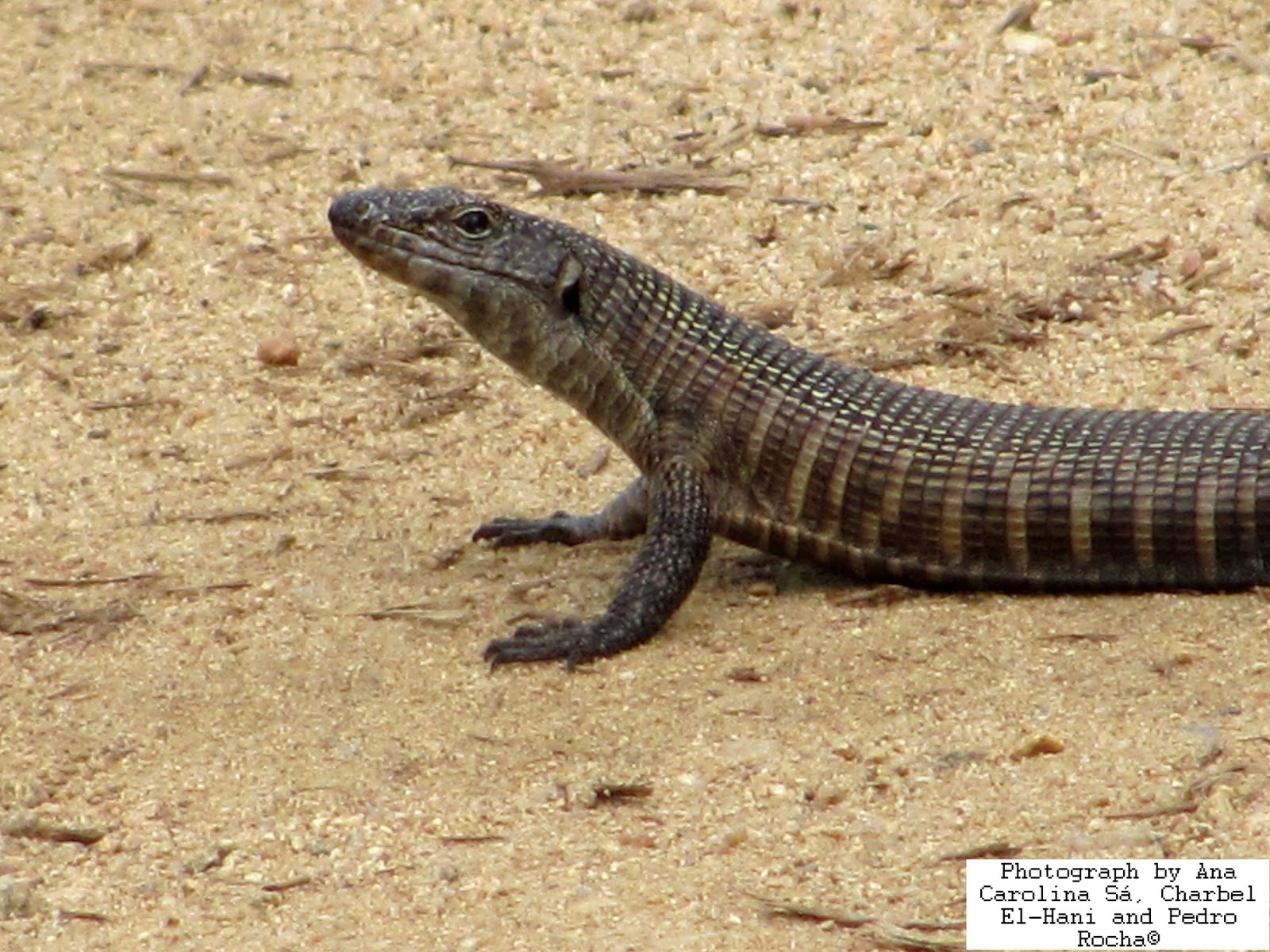
Giant Plated Lizard na Mlambane Road

Abaixo, duas fotos de um Giant Plated Lizard (Gerrhosaurus validus) que vimos cruzando a Mlambane Road. Foi a única vez que vimos esse belo lagarto em 14 dias no parque.

Below, two pictures of a Giant Plated Lizard we saw crossing the Mlambane Road. It was the only time we saw this beautiful lizard in 14 days in the park.


domingo, 16 de outubro de 2011

Impalas na Mlambane Road

Na Mlambane Road, vimos um grupo muito grande de Impalas (Aepyceros melampus).

Na primeira foto, flagramos seis filhotes, alguns deles olhando atentos para esse grande animal que se aproximava (nosso carro), sobre uma grande pilha de esterco, provavelmente de elefante. Elefantes são grandes adubadores, não? Aliás, é comum encontrar esterco nas estradas do Kruger. Elas parecem locais preferidos para os animais usarem de banheiro... Ou, como dizíamos, de modo delicado, no caso é bosta!

Na segunda foto, uma Impala urinando...

In Mlambane Road, we found a very large group of Impalas (Aepyceros melampus).

In the first picture, we caught six cubs, some of them looking attentive at this big animal approaching (our car), over a big pile of dung, probably from an elephant. Elephants are great fertilizers, don't you think? It is usual to find dung in the Kruger roads. They seem to be preferred places for the animals to use as bathroom. Or, as we gently said, in this case it is crap!

In the second photo, an Impala urinating...


sábado, 15 de outubro de 2011

Rola-do-Cabo (Cape Turtle Dove) na Mlambane Road

As rolas-do-cabo são aves simpáticas, como vocês podem ver nessa foto, tirada na Mlambane Road. São comuns no Kruger. Na verdade, são extremamente comuns em todo o sul da África, sendo encontrada não somente em ambientes nativos, mas também em fazendas e jardins nas cidades. Ela se alimenta principalmente de sementes, frutos, néctar, folhas e insetos. A fêmea coloca de 1 a 4 ovos por vez, incubados por ela e pelo macho por 13-16 dias. Os rebentos ficam no ninho de 16 a 17 dias e ainda dependem dos pais por mais 12 dias antes de se tornarem totalmente independentes.

Cape Turtle Doves are nice birds, as you can see in this picture, taken in Mlambane Road. They are common in the Kruger. In fact, they are extremely common in all Southern Africa, being found not only in native environments but also in farms and city gardens. They feed mainly on seeds, fruits, nectar, leaves, and insects. The female puts 1-4 eggs each time, incubated by her and the male for 13-16 days. The offspring remain in the nest 16-17 days and still depend on the parents for 12 days more before becoming fully independent.

quinta-feira, 13 de outubro de 2011

Uma dica - como ver as fotos maiores

Uma dica: se pedirem para abrir as fotos em outra janela, em vez de apenas clicarem sobre elas, poderão ver as fotos em tamanho maior.

A hint: if you ask to open the pictures in a new window, instead of just clicking on them, you'll be able to see them in a bigger size.

Dois bandos de Kudus machos solteiros na Mlambane Road

Vimos dois grupos de Kudus (Tragelaphus strepsiceros) na Mlambane Road. No primeiro grupo, havia 7 machos. No segundo, 6 machos. Vimos ainda uma luta entre dois machos, o que foi um dos eventos mais impressionantes de toda a viagem. E era apenas o segundo dia no Kruger! Acompanhamos toda a luta até um dos machos admitir a derrota e desistir. Por vezes, quando se envolvem em lutas, Kudus terminam enganchados por seus cornos em espiral, o que acarreta a morte dos animais. Felizmente, isso não aconteceu nesse caso.

Kudus estão distribuídos pelo sul e leste da África, mas atualmente com pequenas populações na maioria das áreas, devido à perda de habitat e à caça. No Kruger, existem atualmente 11.000 Kudus. O emblema do parque mostra um desses animais.

Os machos são muito maiores do que as fêmeas e também apresentam crinas na parte inferior do pescoço. Os cornos são exclusivos dos machos, apresentando duas volta e meia. Se medidos em linha reta, alcançam 1 metro de comprimento em média. Os cornos começam a crescer quando os machos atingem idade de 6 a 12 meses. Por volta de dois anos de idade, eles apresentam a primeira volta e somente com seis anos chegam às duas voltas e meia. Estes animais alcançam a maturidade sexual entre 1 e 3 anos de idade. Em cativeiro, Kudus chegaram a viver até 20 anos.

Seus predadores são, em geral, leões, leopardos e cachorros-selvagens africanos. Chitas predam usualmente fêmeas vulneráveis e filhotes, já que não conseguem derrubar os grandes machos. Quando o bando é ameaçado por predadores, chamados de alerta são emitidos por um adulto, geralmente uma fêmea. Em terreno montanhosos, os Kudus têm mais chance de escapar de seus predadores, mas em terreno aberto não são suficientemente velozes para fugir deles. Eles tentam, então, livrar-se dos predadores pulando sobre arbustos e árvores pequenas.

As fêmeas vivem em bandos de seis a vinte indivíduos, juntamente com os filhotes. Cada fêmea geralmente tem um filhote apenas, às vezes dois.

Machos tendem a ser solitários. Mas, às vezes eles formam bandos de solteiros, com 4 a 8 machos jovens e, às vezes, também um macho mais velho. Portanto, vimos na Mlambane Road dois grupos de solteiros.

We saw two groups of Kudus (Tragelaphus strepsiceros) in Mlambane Road. In the first group, there were 7 males. In the second, 6 males. We also saw a fight between two males, one of the most impressive events of the whole trip. And it was only the second day in Kruger! We followed the whole fight until one of the males acknowledged the defeat and gave up. Sometimes, when they fight, Kudus end up hooked up by their spiral horns, which causes the animals' death. Luckily, this did not happen in this case.

Kudus are distributed through eastern and southern Africa, but currently in small populations in most areas, due to habitat loss and hunting. In the Kruger, there are currently 11,000 Kudus. The emblem of the park shows one of these animals.

Males are much bigger than females and exhibit a mane in the lower part of the neck. Horns are exclusively found in males, showing two and a half twists. If measured in straight line, they reach 1 m on average. The horns begin to grow when the males reach 6-12 months of age. Around two years of age, they show the first turn and only at six yeares they reach two and half turns. These animals are sexually mature between 1-3 years of age. In captivity, Kudus reached up to 20 years of age.

Their predators are generally lions, leopards and african wild dogs. Cheetahs usually hunt vulnerable females and calves, since they do not manage to bring a big male down. When the herd is threatened by predators, an alarm call is emitted by an adult, generally a female. In hilly terrains, Kudus have greater chance of escaping their predators, but in open fields they are not fast enough to run away from them. They try, then, to get rid of the predators by jumping over shrubs and small trees.

Females live in herds of six to twenty individuals, alongside with the calves. Each female generally has one calf only, sometimes two.

Males tend to be solitary. But, sometimes they form herds of bachelors, with 4 to 8 young males and, sometimes, also an older bull. Therefore, we saw in Mlambane Road two herds of bachelors.

A primeira foto mostra um bando de 4 machos, todos deitados.Na segunda, podemos ver um macho de Kudu em detalhe. As três fotos seguintes mostram o combate entre os machos, sendo que na última vemos o desfecho, com um dos machos abandonando o combate.

The first picture shows a herd of 4 males, all lying down. In the second, we see a male Kudu in detail. The three following pictures show the fight between the males. In the last, the end of the battle, with one of the males leaving.


terça-feira, 11 de outubro de 2011

Lilac-Breasted Roller (Rolieiro-de-Peito-Lilás) na Mlambane Road

Estas fotos estão entre as melhores que tiramos em toda a viagem: um Rolieiro-de-Peito-Lilás na Mlambane Road! Esta ave combina uma paleta impressionante de cores, não acham? Ela é largamente distribuída pela África Subsaariana e pelo sul da Península Arábica. A razão pela qual se coloca de modo tão conspicuo sobre árvores reside em que, deste ponto, ela pode visualizar seus alimentos, insetos, lagartos, escorpiões, caramujos, pequenas aves e roedores.

Lembro a vocês que, para ver as fotos maiores, basta clicar sobre elas.

These pictures are among the best we took in the whole trip: A Lilac-Breasted Roller in Mlambane Road! This bird combines an impressive palette of colours, don't you think? It is widely distributed in sub-Saharan Africa and the southern Arabian Peninsula. The reason why it perches so conspicuously at lie in the fact that from these points it can spot their food, insects, lizards, scorpions, snails, small birds and rodents.

Remember that to see the pictures in a larger format you just have to click on them.


segunda-feira, 10 de outubro de 2011

Mlambane Road (S118)

Nosso plano era visitar um dos abrigos espalhados pelo Kruger para a visualização de animais, Gardenia, na James Road (S119). Os abrigos são locais muito interessantes, situados em frente a reservatórios de água, onde o visitante pode ficar escondido para visualizar animais. Se você visita o parque no inverno, quando o clima está seco, ficar num desses abrigos é garantia de muitos avistamentos. No verão, como tem muita água no interior da savana, os animais não frequentam muito os reservatórios. Assim, o mais provável é que você visualize animais que costumam ficar na água ou próximo a ela, como hipopótamos ou aves aquáticas, por exemplo. Mas como ficará evidente ao longo desse relato de viagem, vale muito a pena visitar os abrigos.

Descer a Mlambane Road (S118) foi, contudo, uma atração em si mesma, embora fosse uma estrada curta. Para ver o caminho, http://www.gomag.co.za/kruger/game_viewing_areas/game_viewing_berg_en_dal.html

Nesta estrada, avistamos e fotografamos:
1 grupo muito grande de Impalas (Aepyceros melampus)
1 Calau-de-Bico-Vermelho (Tockus erythrorhynchus)
1 Rolieiro-de-Peito-Lilás (Coracias caudatus)
+ 3 grupos de Impalas (Aepyceros melampus)
7 Kudus – Machos (Tragelaphus strepsiceros)
2 Pica-Bois-de-Bico-Vermelho  (Buphagus erythrorhynchus)
1 Rola-do-Cabo (Streptopelia capicola)
1 Giant Plated Lizard (Gerrhosaurus Validus)
+ 6 Kudus – Machos (Tragelaphus strepsiceros)

Our plan was to visit one of the hides scattered through the Kruger for animal sighting, Gardenia, in James Road (S119). The hides are very interesting places, situated in front of water reservoirs, where the visitor can hide to see animals. If you visit the park in the winter, when the climate is dry, stay in one of these hides is a guarantee of many sightings. In summer, as there is much water inside the savannah, the animals do not come very often to the reservoirs. Thus, it is more likely that you see animals that stay in the water or close to it, such as hippos or aquatic birds, for instance. But as it will become evident along this travel report, it is very worthwhile visiting the hides.

To go down Mlambane Road (S118) was, however, an attraction in itself, despite being a short road. To see the way, http://www.gomag.co.za/kruger/game_viewing_areas/game_viewing_berg_en_dal.html

In this road, we saw and photographed:

1 veery large group of Impalas (Aepyceros melampus)
1 Red-Billed Hornbill (Tockus erythrorhynchus)
1 Lilac-Breasted Roller (Coracias caudatus)
+ 3 groups of Impalas (Aepyceros melampus)
7 Kudus – Males (Tragelaphus strepsiceros)
2 Red-Billed Oxpeckers (Buphagus erythrorhynchus)
1 Cape Turtle-Dove (Streptopelia capicola)
1 Giant Plated Lizard (Gerrhosaurus Validus)
+ 6 Kudus – Males (Tragelaphus strepsiceros)

Para começar, um Calau-de-Bico-Vermelho comendo um besouro que encontrou numa imensa pilha de esterco deixada por um macho de rinoceronte branco para marcar seu território. Há toda uma cadeia trófica nas estradas do Kruger, o que ajuda a visualização de animais nelas. Como os animais usam com muita frequência as estradas para deslocar-se, há bastante esterco nelas, que, por sua vez, mostra grande riqueza de insetos. Aves insetívoras, como este Calau, comem insetos na estrada e isso atrai, então, outros carnívoros, como águias, por exemplo. Então, siga as estradas, preste atenção nas pilhas de esterco e você será bem sucedido em encontrar animais. Nõs encontramos mais de cem todos os dias, sem exceção!

To begin, a Red-Billed Hornbill eating a beetle found in an immense pile of dung left by a white rhino bull to mark its territory. There is a whole trophic chain in the Kruger roads, what helps in seeing animals in them. As the animals often use the roads to move, there is a lot of dung in them, which, in turn, shows a wealthy of insects. Insectivore birds, such as this Hornbill, eat insects in the road and this attracts, then, other carnivores such as eagles, for instance. So, follow the roads, pay attention in the dung piles, and we will be successful in finding animals. We found every day more than a hundred, no exception!


Malelane Road (H3)

Malelane Road (H3) recebe seu nome por ser a estrada de asfalto por onde se entra no Kruger quando se escolhe como porta de entrada o portão Malelane ao sul. A região sul do parque corresponde à reserva de caça Sabi, estabelecida em 1898. A reserva a partir da qual o Kruger foi criado tinha função de controlar a caça e proteger o número de animais na região, muito reduzido pela caça excessiva. Ela correspondia então a um terço do parque original. Em 1926, o parque Kruger foi criado a partir da fusão da reserva Sabie com a reserva de caça Shingwedzi e de algumas fazendas. A história do parque pode ser lida em http://en.wikipedia.org/wiki/Kruger_National_Park


A Malelane Road é um ponto principal de acesso ao parque e, assim, pode receber um tráfego pesado durante fins de semanas e feriados. Caso visite o parque num período como este e precisar percorrer esta estrada, ou algum outro dos principais acessos, você pode utilizar a rede de estradas de terra como caminho alternativo.

Malelane Road (H3) receives its name because it is the tar road through which one enters the Kruger when one chooses Malelane gate at the south as an entry point. The southern region of the park corresponds to the Sabi Game Reserve, established in 1898. The reserva from which the Kruger was created had the role of controlling hunting and protecting the number of animals in the region, much diminished due to excessive hunting. It amounted to one third of the original park. In 1926, the Kruger park was created by the fusion of the Sabie reserve with the Shingwedzi Game Reserve and some farms. The history of the park can be read at http://en.wikipedia.org/wiki/Kruger_National_Park

Malelane Road is a main access point into the park and, thus, can receive heavy traffic during weekends and holidays. If you visit the park at such period and need to follow this road, or any of main access points, you can use the network of gravel roads as alternative way.

domingo, 9 de outubro de 2011

Paisagens na Malelane Road

Três paisagens na Malelane Road. Primeiro, um rio seco. Bom lugar para encontrar animais ou seus rastros. Mas nesse caso não os encontramos. Segundo, uma visão da estrada e da paisagem ao redor. Terceiro, uma visão da savana com seu belo céu.

Three landscapes in Malelane Road. First, a dry river bed. Good place to find animals and their tracks. But in this case we didn't find. Second, a view of the road and the surrounding landscape. Third, a view of the savannah and its beautiful sky.